
Tales of Eternia Remastered Changes
Part 1 is the original game as Wikipedia records it, including a Japanese release in November 2000 and a North American release in September 2001. Part 2 is the remaster feature list from Bandai Namco and Steam only, plus the October 15, 2026 update v2.0.0. Review claims about a new English dub, fully voiced skits, a missing Grade Shop, or a PSP-based build are not official change-list items. A Wikipedia sentence does not get copied into the remaster list. Those claims are labeled on the reviews page. Tales of Eternia Remastered Changes is split on purpose.
Direct answer
- Wikipedia dates the original PlayStation release to November 2000 in Japan and September 2001 in North America, under the name Tales of Destiny II, which is not the PlayStation 2 game Tales of Destiny 2.
- Bandai Namco’s remaster list includes a graphics switch, English and Japanese voice audio, Battle Retry, Boost, and Extreme selectable from the start.
- Update v2.0.0 on October 15, 2026 adds Font Style for Japanese text, lets a second playthrough inherit titles, and includes text fixes.
- A new English dub, fully voiced skits, a missing Grade Shop, and a PSP-based build are review claims, not official change-list items.
Advertisement
Part 2: picture, sound, and the voice-language switch
Bandai Namco Entertainment America's June 9, 2026 news says the remaster can switch graphics and sound effects between the new presentation and the original. Nintendo Life's July 19, 2026 translation of the Japanese change list names the picture control Graphics Mode and the sound control SE Mode, and it says you can switch at any time while the interface stays on the remastered UI. America's news uses the label SFX Mode for the sound switch. This page keeps both labels because both documents are official material, and it does not collapse them into an unstated third name. The switch is a presentation option. It is not, in those documents, a promise about resolution on Switch 2 or about a filter setting.
Voice language is also official, and it is narrower than a reviewer's description of a new dub. Bandai Namco Europe's October 8, 2026 article says the game has English and Japanese voice audio. The July 19 translation includes a voice-language switch. Those lines say you can choose between the two languages. They do not, in the wording checked, say the English performances were recorded for this remaster, and they do not say skits are fully voiced. Some reviews do say that. The reviews page marks those lines as review claims. Part 2 stops at the switch the publisher actually listed.
Gameplay reference
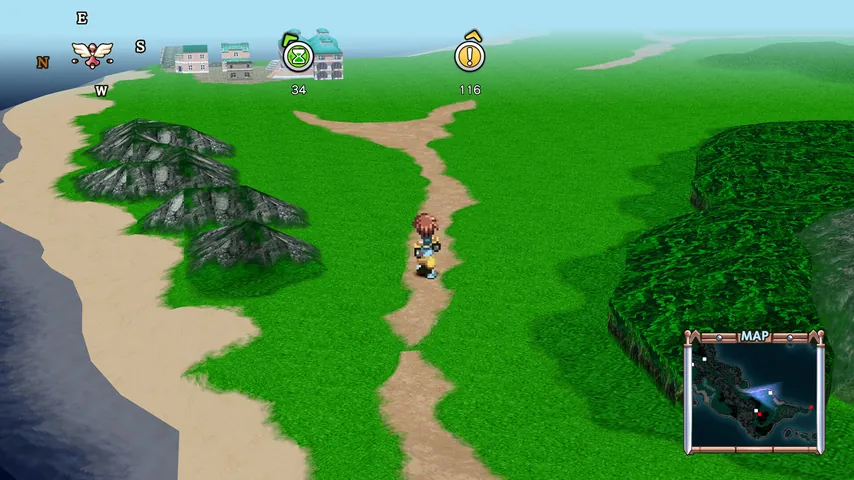
Steam store screenshot of the world map. A compass sits at the upper left, an hourglass icon reads 34, a yellow exclamation mark reads 116, and the corner minimap is labeled MAP. The July 19 translation of Bandai Namco's change list describes destination and timed-event icons with distances. The numbers are this frame's distances, not a route.
Steam store · Bandai Namco Entertainment · Reviewed 2026-10-16
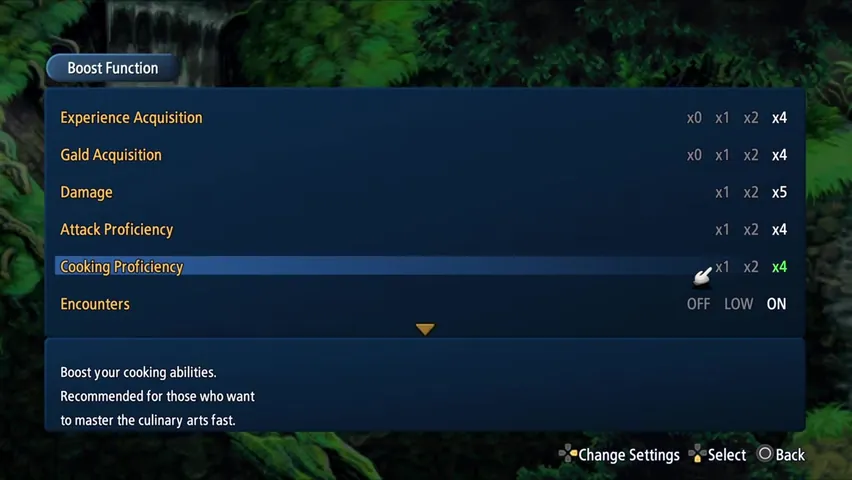
Boost Function menu in Geek Culture Plays' September 23, 2026 PS5 preview, at 13:34. Cooking Proficiency is highlighted at x4, and the help line recommends it for learning cooking quickly. America's June 9 news names Boost for experience and encounters. The full rows are read on the beginner page. Pre-release footage, not a Glint menu.
Geek Culture Plays · 13:34 · Reviewed 2026-10-16
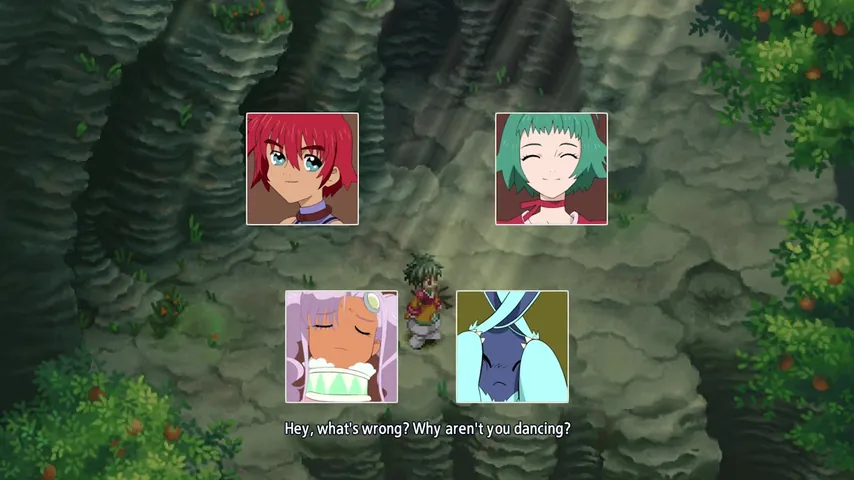
Portrait scene on Nintendo Switch in Pelvic Gaming's October 14, 2026 recording, at 4:40. The burned-in subtitle reads Hey, what's wrong? Why aren't you dancing? The official list adds a Skit Player and the ability to skip or pause skits. Whether these scenes are fully voiced is a review claim, not a line in that list.
Pelvic Gaming · 04:40 · Reviewed 2026-10-16
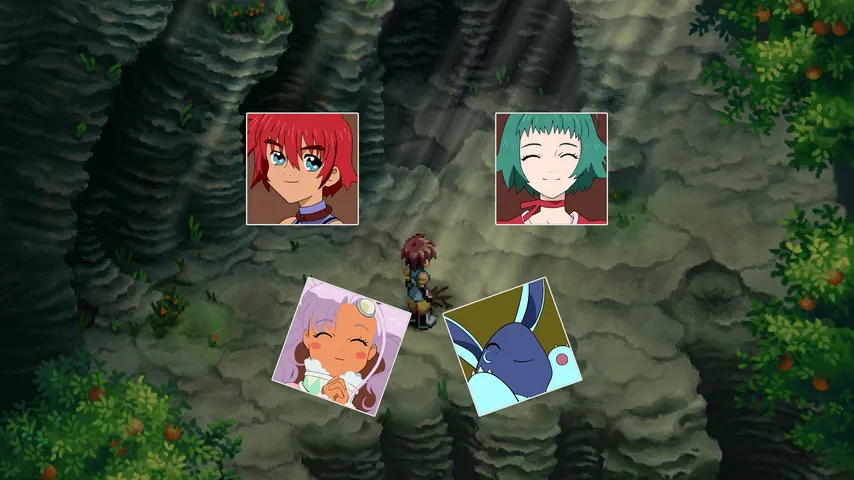
Steam store screenshot of a portrait scene in a rocky grove. Four faces sit around a small field sprite, and two of the frames are tilted. No subtitle is burned into this store image. It shows the portrait layout the remaster uses. It does not, by itself, prove a voice track.
Steam store · Bandai Namco Entertainment · Reviewed 2026-10-16
Part 2: markers, movement, events, and saves
The July 19 translation of Bandai Namco's Japanese change list is the long inventory for field tools. It describes icons for the main destination, for valuables, for timed events, and for new-skill events. Distances are shown, and the icons can be turned off. The Steam store screenshot on this page shows one world map with a compass, an hourglass icon marked 34, a yellow exclamation mark marked 116, and a minimap labeled MAP. Those two numbers are what that frame prints. They are an example of the distance readout, not a walkthrough coordinate. The list's marker types line up with a yellow exclamation for the main goal and an hourglass for a timed event. A star for valuables and a blue exclamation for a new skill are in the written list. This particular Steam frame does not show the star or the blue mark.
The same translation adds high-speed movement across a scene and a default choice between walking and running. Events, skits, and movies can be skipped or paused. Text can advance on its own. The game auto-saves. You can return to the title screen and load from the menu. Master volume and brightness are in the list. Minigames can be skipped, and a minigame can be retried without leaving it first. Skit Player and Sound Player are added as ways to revisit those scenes and tracks. The translation says the original Sound Test was removed. That removal is an official list item. It is not the same sentence as a claim about which region's original disc cut skits out. The regional-cut claim is a review claim and is kept off this list.
Part 2: battle tools, Boost, labyrinth, and difficulties
America's June 9 news and the July 19 translation both describe battle conveniences: Battle Retry, Quick Recovery as a one-button recovery, and a high-speed Auto battle mode. America's news describes Boost as control over experience and over how often encounters happen. The July 19 translation also lists Boost. The exact multiplier steps visible on the Boost Function menu, including Gald, damage, weapon proficiency, cooking proficiency, and the OFF, LOW, and ON encounter settings, are read from a September 23, 2026 preview frame on the beginner page. They are menu readings, so they are not restated here as if the June 9 press release had printed every step. New skill names can appear in green text. Button prompts are added, and field buttons can be remapped.
Two pieces of content move earlier than in the original, according to the July 19 translation. Nereid's Labyrinth can be entered on a first playthrough once you are inside Shizel Castle. The translation says the original game waited until a second playthrough. America's June 9 news says a high difficulty named Extreme can be selected from the start, and that a new difficulty named Unknown unlocks after you clear the game. The July 19 translation says the higher difficulty is available on a first playthrough, where the original game required a second playthrough, and it places the new top difficulty from a second playthrough onward. That translation does not use America's English name Extreme. This page still says Extreme and Unknown, because those are the names in Bandai Namco Entertainment America's English news, and it does not print a second spelling. The two clocks for Unknown are both in official material, and they disagree. Check the menu in the copy you bought.
Part 2: New Game Plus, the arena, and update v2.0.0
The July 19 translation says a second playthrough can inherit progress, and that you choose the inherited pieces one by one. At that July date the translation said titles are not among the inherited pieces. Bandai Namco's October 15, 2026 notice for version 2.0.0 changes that point. The notice says titles can be inherited on a second playthrough. It also adds a Japanese font option named Font Style and includes text fixes. The July sentence about titles is the older official list. The October 15 sentence is the current one. Download sizes for v2.0.0 are on the release-date page, so they are not repeated as a second spec sheet here.
Other list items that are easy to miss: the champion match in the Inferia arena can be challenged again, and the reward is once per playthrough. Automatic cooking defaults to the character with the highest cooking proficiency. A battle-music setting is limited to the Deluxe Edition and the Deluxe Upgrade Pack. The Steam announcement's description of that music option, including the rule that those tracks replace music only for random encounters, is on the release-date page with the price. Part 2 records the setting as a Deluxe-gated option. It does not reuse Wikipedia's album note to explain the paid music.
Part 1: Wikipedia on the 2000 and 2001 releases
Wikipedia's article on Tales of Eternia, as checked on October 16, 2026, dates the PlayStation release to November 2000 in Japan and September 2001 in North America. The North American name on that page is Tales of Destiny II. Wikipedia says that PlayStation name is not the PlayStation 2 game Tales of Destiny 2. The PlayStation 2 game is a separate sequel to Tales of Destiny. Anyone comparing the remaster with an old disc should read the disc title before assuming the 2026 game continues the PlayStation 2 story. This page does not add a plot link the article does not state.
Bandai Namco's current English pages say the game was originally released in 2001. America's June 9, 2026 news post says it launched in North America under the name Tales of Destiny II. That official 2001 line matches Wikipedia's North American month and year. It does not, in the pages checked, mention the November 2000 Japanese release. The gap is a dating difference between the Japanese launch and the North American launch, not a second remaster. Part 2 does not turn 2000 or 2001 into a feature of the 2026 build. The year contrast belongs here, next to the citation, so a store line that only says 2001 is not mistaken for a denial of the Japanese date.
Advertisement
Part 1: Wikipedia on the team, the PSP port, sales, and the anime
Wikipedia attributes the original development to members of Wolfteam, also identified there as Telnet Japan, working under Namco. It calls the game the third mainline entry in the Tales series. Character design is credited to Mutsumi Inomata. The animated scenes are credited to Production I.G. The score is credited to Motoi Sakuraba and Shinji Tamura. Wikipedia says the original soundtrack contains 109 tracks. That 109-track sentence is a Wikipedia description of the original album. It is not a remaster patch note. Steam's separate announcement that the Deluxe soundtrack includes all 109 in-game BGM tracks is a product fact on the release-date page, cited to Steam, and it is not copied into the table on this page as if Wikipedia had written the Deluxe listing.
The same Wikipedia article describes a PSP port released in Japan on March 3, 2005, and in PAL regions in February 2006 with Ubisoft as the publisher. It says that PSP version did not release in North America. Worldwide sales are given as about 873,000 copies as of December 2007. Wikipedia also notes a 13-episode anime by the studio Xebec. None of those sentences describe a 2026 menu, a difficulty name, or a quality-of-life toggle. They stay in Part 1 so the remaster list cannot quietly absorb a sales total or a PSP date. Whether reviewers think the remaster's pictures follow the PSP version is a different claim, and it is not Wikipedia's sales paragraph.
What this page refuses to file as an official change
Four claims show up in reviews and are absent from Part 2. Some reviews say there is a new English dub. Some reviews say the skits are fully voiced. Shacknews, CGMagazine, and Push Square say skits were removed from the original North American release. CGMagazine and Shacknews say the remaster is based on the PSP version. Push Square says there is no Grade Shop, matching the original, and that modifiers are direct toggles. None of those sentences appear in the Bandai Namco or Steam documents used for the table. Writing them into the table would turn a review into a patch note. The reviews page quotes the outlet, the score where one was published, and the limit of the claim.
Shacknews also criticizes how backgrounds and animated scenes were enlarged and how the picture was fit to 16:9. That is a scored opinion of the PC build, not a row in the publisher's change list. Graphics Mode, in the official list, is a switch between remastered and original presentation. It is not an apology for a filter, and it is not a denial of the review. Bandai Namco Entertainment America's opening movie, posted July 6, 2026, uses GARNET CROW's song flying. That is the official opening the publisher posted. It is not a Wikipedia credit.
How the two parts stay apart
Tales of Eternia Remastered Changes answers a search that mixes two different objects: the PlayStation game from the start of the 2000s, and the 2026 remaster. The sources checked on October 16, 2026 do not use one document for both. Wikipedia is the source for the original release years, the North American name, the studio history, the PSP port, the sales figure, the composers, and the anime. Bandai Namco's English news, Bandai Namco Europe's October 8 article, Steam's own posts, and Nintendo Life's July 19, 2026 English translation of Bandai Namco's Japanese change list are the sources for what the remaster adds. The July 19 piece is a translation of the publisher's list, which is why it is allowed in Part 2. It is not a review.
If a fact below is introduced with Wikipedia, it stays in Part 1. It is not repeated as a remaster bullet. If a fact is introduced with Bandai Namco or Steam, it stays in Part 2. Reviewers have said additional things about voices, skits, a Grade Shop, and which older build the remaster follows. Those sentences are absent from Part 2 on purpose. The reviews page names the outlet for each one. Difficulty and place names in Part 2 follow Bandai Namco Entertainment America's English news: the opening high difficulty is Extreme, and the new top difficulty is Unknown.
Video evidence
Feature overview by GVG
Creator video published June 10, 2026, about 11 minutes 59 seconds, around 11:55 UTC+8 on October 16, 2026. Logged chapters cover localization and voices, quality-of-life options, picture settings, and difficulty. Not a Bandai Namco patch note, and no still from this video is used on the page.
Official opening movie by Bandai Namco Entertainment America
Official opening published July 6, 2026, using GARNET CROW's song flying. in the October 16 capture. About 2 minutes 31 seconds.
Sources & methodology
How the change list and the overview video were checked
The comparison is based on Bandai Namco's announcements and update notice, the translated Japanese change list, the Steam page, and Wikipedia's entry on the original game (sources listed below).
GVG posted a creator video about announced details on June 10, 2026. The chapters logged with that video cover localization and voices, quality-of-life options, picture settings, and difficulty. The video is embedded as a creator overview. No still was taken from it for this page, and its narration is not an extra official bullet.
Source links
Part 1 only: 2000 and 2001 dates, Tales of Destiny II, Wolfteam, PSP port, sales through December 2007, staff, soundtrack count, and the Xebec anime. Accessed October 16, 2026.
Graphics and SFX switches, Boost, destination icons, Auto battle, Battle Retry, Quick Recovery, Extreme from the start, Unknown after a clear. Accessed October 16, 2026.
English translation of Bandai Namco's Japanese change list. Used for Part 2 details. The later v2.0.0 notice overrides the July line that titles are not inherited.
Font Style, title inheritance on a second playthrough, and text fixes. Accessed October 16, 2026.
English and Japanese voices, and the original-versus-remaster presentation switch. Accessed October 16, 2026.
Source of the world-map and skit screenshots. Store copy is not used where it disagrees with America's English place name. Accessed October 16, 2026.
FAQ
When did the original Tales of Eternia release?
Wikipedia, checked October 16, 2026, says November 2000 in Japan and September 2001 in North America, under the name Tales of Destiny II. Bandai Namco's English pages say 2001, which matches the North American year and does not mention the Japanese month.
Is Tales of Destiny II the same game as Tales of Destiny 2?
Wikipedia says no. Tales of Destiny II is the North American PlayStation name of Tales of Eternia. Tales of Destiny 2 is a separate PlayStation 2 sequel to Tales of Destiny.
What did update v2.0.0 change?
Bandai Namco's October 15, 2026 notice says v2.0.0 adds the Japanese font option Font Style, lets a second playthrough inherit titles, and fixes text. A July 19 translation had said titles were not inherited. The October notice is the later rule.
Can you play on Extreme immediately?
Bandai Namco Entertainment America's June 9, 2026 news says Extreme is available from the start, and that Unknown unlocks after you clear the game. A July 19 translation of the Japanese list places the new top difficulty on a second playthrough. The retail menu was not checked in person.
Did the original North American release cut the skits?
That sentence comes from reviews, including Shacknews, CGMagazine, and Push Square. It is not a line in the official change list on this page. See the reviews page for how those outlets put it.
Related Pages
Advertisement